

Types of dental implants differ in five ways. First, they vary by material and by where the implant sits in the jaw. Then loading time, the restoration on top and the width complete the list. This guide explains each option and links to the relevant treatment page.
How many types of dental implants are there?
There is no single number, because dentists sort implants in five ways at once. These are material, position, loading time, the restoration on top and diameter. So one patient might have a titanium implant that carries a single crown. In other words, every implant is a mix of choices, not one label.
Why the five categories matter
Online lists of dental implant types often mix product names with clinical terms. But that hides the real decisions. Each category answers a different question your dentist must settle. The table below sets them out.
| Way of classifying | Main options | What it tells you |
|---|---|---|
| Material | Titanium, the standard and the material we use | How the implant bonds with bone and how much research backs it |
| Position | Endosteal (standard), zygomatic, subperiosteal | How the implant anchors in the face |
| Loading time | Immediate, early, conventional | When the teeth go on |
| Restoration | Crown, bridge, fixed full arch, implant-retained denture | What the implant replaces |
| Diameter | Standard, narrow, mini | How much bone and space it needs |
Where does the implant sit: endosteal, subperiosteal or zygomatic?
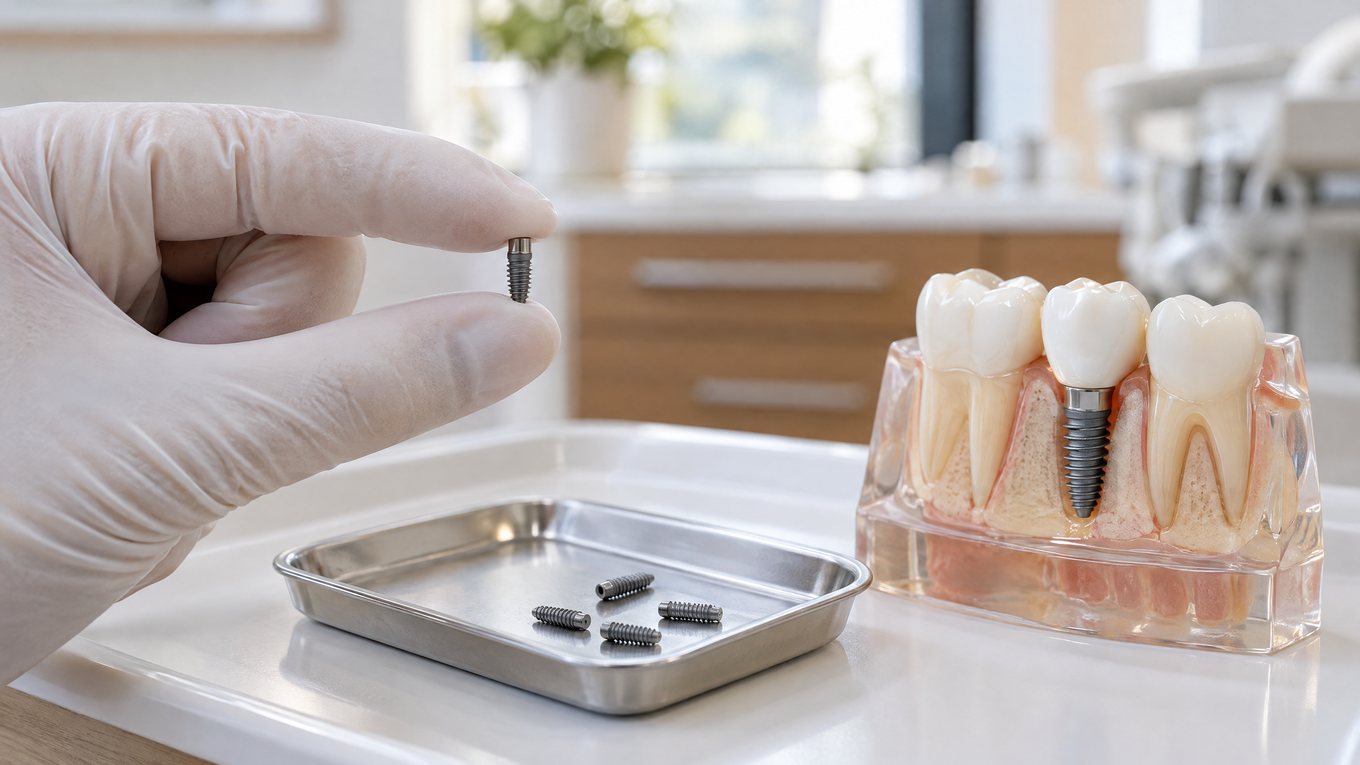
Of all the types of dental implants, the endosteal screw is the everyday choice. It sits inside the jawbone and bonds with it over several weeks to months. After that, it can support the new tooth. Subperiosteal and zygomatic implants exist for severe bone loss. Still, they remain specialist options that few patients need.
- Endosteal implant
- A screw-shaped implant placed inside the jawbone; the standard design today.
- Subperiosteal implant
- A custom frame that rests on the bone under the gum, used rarely for severe bone loss.
- Zygomatic implant
- A long implant anchored in the cheekbone when the upper jaw has very little bone.
- Osseointegration
- The direct, stable bond that forms between the implant surface and living bone.
- Abutment
- The connector that joins the implant to the crown, bridge or denture above it.
When there is not enough bone
Before turning to rare designs, a dentist usually tries simpler routes. For example, a bone graft can rebuild a thin ridge. Similarly, a sinus lift adds height in the upper back jaw. Where bone loss is severe, our clinic assesses zygomatic or subperiosteal implants for suitable cases.
Why is titanium the standard implant material?
Titanium bonds directly with living bone, copes well with chewing forces and has decades of clinical use behind it. As a result, most long-term implant research follows titanium screws. Ceramic (zirconia) implants also exist. At our clinic, we use titanium implants.
How titanium bonds with bone
A thin oxide layer forms on the titanium surface on its own. Bone cells then attach to this layer and gradually grow around the implant. Dentists call this process osseointegration. Modern implants have a slightly roughened surface as well, which gives the bone more area to grip.
What ten years of data show
A 2019 meta-analysis pooled 18 prospective studies of solid screws with roughened surfaces. Overall, ten-year survival at the implant level came to 96.4%. A stricter sensitivity analysis, which allowed for patients lost to follow-up, gave 93.2%.
What about titanium allergy?
True titanium allergy is rare. Even so, tell your dentist about any past reactions to metals. If needed, they can refer you to an allergy specialist first.
When do the teeth go in? Immediate, early and conventional loading
Loading means fixing a biting tooth or bridge onto the implant. A Cochrane review uses three timings. Immediate loading happens within one week, and early loading between one week and two months. Conventional loading comes later, after two months. Bone quality and how firmly the implant grips at surgery decide which one suits you.
The review pooled 26 randomised trials with 1,217 participants and 2,120 implants. It found “no convincing evidence of a clinically important difference in prosthesis failure, implant failure, or bone loss” between loading times. For immediate or early loading, a torque of at least 35 Ncm “seems to be one of the prerequisites”.
Esposito M et al. Different times for loading dental implants. Cochrane Database of Systematic Reviews, 2013.
Same-day implants
With immediate loading, you usually leave with temporary teeth fixed on the new implants. That only works when the implants sit very firmly, so not every mouth qualifies. Our same-day implants page explains the treatment in more detail.
A different idea: immediate placement
Immediate placement means putting the implant into the socket at the extraction visit. Loading, by contrast, describes when the tooth goes on. The two can happen together, but they are separate decisions. So ask which one a clinic means by “same-day”.
What can an implant hold? Crowns, bridges and full-arch teeth
One implant can carry a single crown. Two or more can support a bridge. Four to six can hold a fixed full arch. Another route is an implant-retained denture that clips on and comes out for cleaning. Only a dentist can remove the fixed options. So these types of dental implants differ mainly by what sits on top.
Single teeth and gaps
When just one tooth is missing, a single tooth implant takes over its root without trimming the neighbours. Where several teeth are missing in a row, an implant-supported bridge spans the gap. It needs fewer implants than missing teeth, so surgery stays smaller.
Full-arch options
On a toothless jaw, All-on-4 implants hold a fixed bridge on four implants. The back two usually lean at an angle for better support. If there is more bone, All-on-6 implants spread the load across six. Instead, some patients choose a snap-in denture on implants, which is simpler and removable. See our full-mouth implants page for more on this type of dental implant.
Are mini implants a real alternative?
The International Team for Implantology (ITI) treats implants up to 3.5 mm wide as narrow. It classes those under 2.5 mm as mini implants. Because they are slim, they can fit tight gaps or thin ridges without grafting. However, the slimmest sizes have less long-term data than other types of dental implants.
Typical uses for mini implants
Mini implants mostly steady a loose denture or act as a temporary support. They can also replace a small front tooth. For back teeth that take heavy chewing forces, dentists generally prefer a standard width. In short, your bone and the load on the tooth set the diameter.
Choosing between dental implant types: what your dentist checks
No catalogue picks the right implant for you. Instead, the choice comes from an examination, your medical history and a 3D cone-beam CT scan, which we use to plan every implant at our clinic. Bone volume, missing teeth and gum thickness all matter, and your expectations shape which types of dental implants make sense.
- First, a full mouth check of gum health and the remaining teeth.
- Next, a 3D cone-beam scan of bone height, width, nerves and sinuses.
- A review of conditions and medicines such as diabetes and blood thinners.
- Questions about smoking, because it slows healing around implants.
- A count of the missing teeth and which jaw they are in.
- Your smile line, gum thickness and the look you want.
- Signs of clenching or grinding, which can overload implants.
- Finally, a plan for cleaning, check-ups and maintenance.
Types of dental implants: your questions
What is the most common type of dental implant?
Which types of dental implants last the longest?
Which implant material does Smile Group use?
Is a snap-in denture the same as All-on-4?
Treatment and everyday life: your questions
Can I still have implants if I have bone loss?
Do mini implants work for a full set of teeth?
How many visits does implant treatment usually take?
Can you be allergic to a titanium implant?
Among all the types of dental implants, the right one becomes clear only after an examination and a 3D scan. Our team in Şişli, Istanbul can talk you through each option. Reach us through our contact page, or read about our dentists before you book.
Written by: Smile Group Clinical Team · Reviewed by our dentists · Last updated: 20 October 2026
Sources: Howe et al., Journal of Dentistry (2019) · Cochrane review on implant loading times (2013) · NHS — Dental treatments · ADA MouthHealthy — Missing teeth