

Knowing how to floss properly matters more than which floss you buy. Good technique lifts plaque from between the teeth instead of pushing it around. Below you will find the method dentists teach and the right tool for each gap. Finally, we look at the research, bleeding gums and when to see a dentist.
Why Brushing Alone Misses the Gaps
A toothbrush cleans the front, back and biting surfaces well. Its bristles, however, barely reach the narrow sides where teeth touch. Plaque left there irritates the gum and feeds decay. Floss or an interdental brush reaches those surfaces, so the two habits work as a pair. That is why learning how to floss pays off.
What plaque does between your teeth
Plaque is a sticky film of bacteria that forms soon after eating. Left alone, it can make gums red and swollen within days. Later it hardens into tartar, which only a professional scale and polish can remove. Trapped food and plaque feed the bacteria behind bad breath too.
How to Floss Without Hurting Your Gums
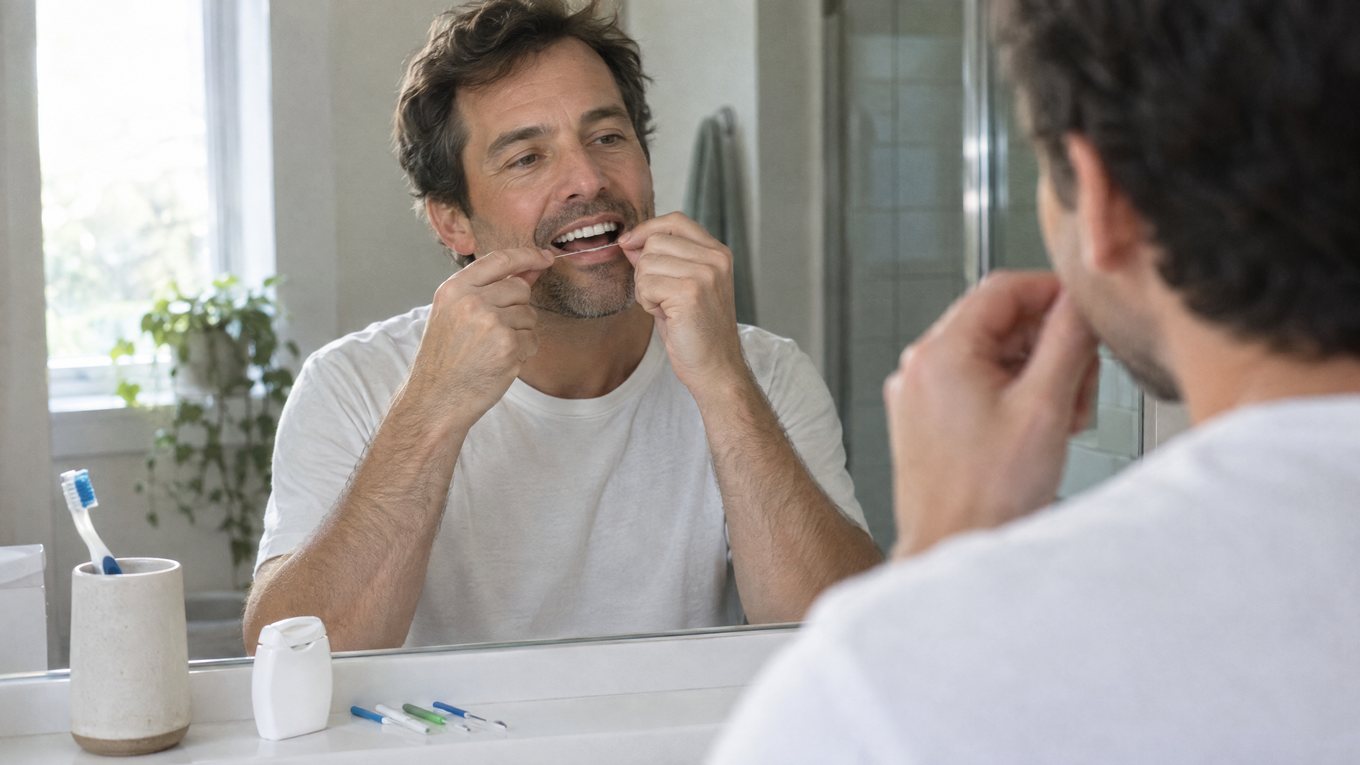
Break off about 18 inches (45 cm) of floss and wind it around your middle fingers. Next, ease it between two teeth with a gentle back-and-forth motion. At the gumline, curve it into a C around one tooth and rub gently. In short, that is how to floss without snapping into the gum.
- Wind most of the floss around one middle finger.
- Wrap the rest around the other middle finger.
- Pinch it between thumbs and index fingers, leaving a short taut section.
- Ease it between two teeth; never snap it down.
- Curve it into a C and slip it just under the gumline.
- Rub up and down a few times, then do the neighbouring tooth.
- Use a clean section for each gap, including behind the back molars.
Finding the right pressure
Stop as soon as you feel gentle resistance below the gum edge. Forcing it deeper can cut the gum, but staying too shallow leaves plaque behind. Flossing should never feel sharp, so ease off if it does.
Getting comfortable at the back
Open your mouth only halfway; a relaxed cheek makes back teeth easier to reach. A mirror helps while you learn how to floss during the first few weeks.
Floss, Tape, Picks or Interdental Brushes?
The right tool depends on the size of the gaps between your teeth. For example, thin waxed floss slides through tight contacts, while wider tape suits larger spaces. Where gaps are wide or gums have receded, a snug interdental brush usually cleans better. Choosing well is half of knowing how to floss.
| Tool | Best for | Watch out for |
|---|---|---|
| Waxed floss | Tight contacts, beginners | Can feel bulky in very narrow gaps |
| Unwaxed floss | Very tight contacts | Frays more easily |
| Dental tape | Wider gaps, sensitive gums | Too thick for tightly packed teeth |
| Floss picks | One-handed use, travel | Harder to form a C shape |
| Interdental brushes | Open gaps, receded gums, braces | Size must match the gap; never force one in |
| Threader or spongy floss | Braces, bridges, implants | Takes a little practice |
| Water flosser | Extra help around braces and bridges | Evidence is limited and inconsistent |
Floss picks: convenient, with one catch
Picks work with one hand, which helps people with limited dexterity. Yet a short, rigid strand cannot hug the tooth like loose floss. So angle the pick against each side of the gap and rub a few times. Throw it away after one use.
- Interdental space
- The gap between two neighbouring teeth, where a toothbrush cleans least well.
- Contact point
- The spot where two teeth touch; floss meets slight resistance as it passes through.
- Plaque
- A soft, sticky layer of bacteria on the teeth that hardens into tartar if left alone.
- Gingivitis
- Gum inflammation, usually showing as redness, swelling and bleeding when you clean.
- Floss threader
- A flexible plastic loop that feeds floss under a brace wire or a bridge.
Is Flossing Actually Worth It?
Yes, for most people, although the research is less dramatic than many assume. A 2019 Cochrane review pooled 35 trials with 3,929 adults. Flossing alongside brushing may reduce gum inflammation in the short and medium term. The certainty of that evidence, however, is low.
Floss or interdental brushes, used with a toothbrush, may reduce gum inflammation and plaque more than brushing alone. Interdental brushes may outperform floss. Most of this evidence is of low or very low certainty.
Summary of Worthington HV et al. Cochrane Database of Systematic Reviews, 2019.
What the review could not show
No trial measured decay between teeth, so the effect on cavities is unknown. Most studies were short, and many participants started with healthy gums. Even so, none reported serious harm. On balance, a few minutes a day still makes learning how to floss worthwhile.
Cleaning Around Braces, Bridges and Implants
Brackets, bridges and implant crowns create places where plaque hides and ordinary floss cannot pass. A threader, or spongy floss with a stiff end, feeds the strand underneath. Interdental brushes usually work faster around brackets. Learning how to floss around dental work takes some practice at first.
How to floss with braces
Thread the stiff end under the main wire between two brackets. Then pull a length of floss through and clean both tooth sides with the C motion. After that, small interdental brushes can tidy around each bracket.
Bridges and implants
So how do you floss under a fixed bridge? Push the threader beneath the false tooth and wipe its underside with the spongy section. Around implants, plaque can inflame the gum just as it does around natural teeth. For that reason, your dentist may suggest an interdental brush with a plastic-coated wire.
Why Do My Gums Bleed When I Floss?
Light bleeding in the first days is common. It usually means plaque has already inflamed the gum. So keep going gently every day. As plaque clears, the inflammation settles and bleeding typically eases within a few days. Many people searching how to use dental floss quit too early.
When bleeding needs a dentist
Book an examination if bleeding continues despite gentle daily cleaning. Swelling, pus, a bad taste or loose teeth also need checking, because they can signal gum disease. Blood thinners make gums bleed more easily, so mention them. Our page on bleeding gums explains the common causes.
Building a Daily Flossing Habit
Clean between your teeth once a day, as the American Dental Association advises. The ADA says the order does not matter. By contrast, the NHS says it is best to floss before brushing. Evening suits many people, because saliva flow drops overnight. Still, once you know how to floss, the right time is simply the one you keep.
Children and flossing
Start cleaning between a child’s teeth once two teeth touch. Parents usually do it at first, and floss picks help. Children then take over as their hand control improves. Our guide to preventing tooth decay in children covers the other steps.
Signs your technique needs work
The usual errors are snapping floss into the gum and reusing a dirty section. Floss that shreds in one gap may point to a rough filling, tartar or decay. Mention it at your next visit, since a filling sometimes just needs smoothing.
Later in life
As gums recede with age, gaps widen and interdental brushes become more practical. Floss holders help when stiff joints make fine movements difficult. Our article on dental health after 60 has more tips.
Questions about technique and tools
How to floss back teeth without gagging?
Is a water flosser as good as string floss?
Do I still need to floss with an electric toothbrush?
Is it normal for flossing to hurt?
Gums, breath and special cases
Why does used floss smell bad?
Should I floss if my gums have receded?
How to floss with arthritis or a weak grip?
How long until my gums stop bleeding when I start flossing?
Learning how to floss takes a little patience, but daily practice soon makes it automatic. To have your technique checked, contact the Smile Group team or meet our dentists in Şişli, Istanbul. Visiting Istanbul for treatment? Ask for a cleaning demonstration before you fly home.
Written by: Smile Group Clinical Team · Reviewed by our dentists · Last updated: 19 October 2026
Sources: Worthington et al., Cochrane (2019) · NHS — How to keep your teeth clean · American Dental Association — Flossing